
F'innews: Segmentation that doesn't suck
April 30th: How we compressed a month of analytics into days, whether you'd trust AI to shop for you, and what an MBA team taught us about our own blind spots (~4 minute read)

A few things worth your four minutes this month:
We Just Compressed a Month of Analytics Into Days
Introducing Motive
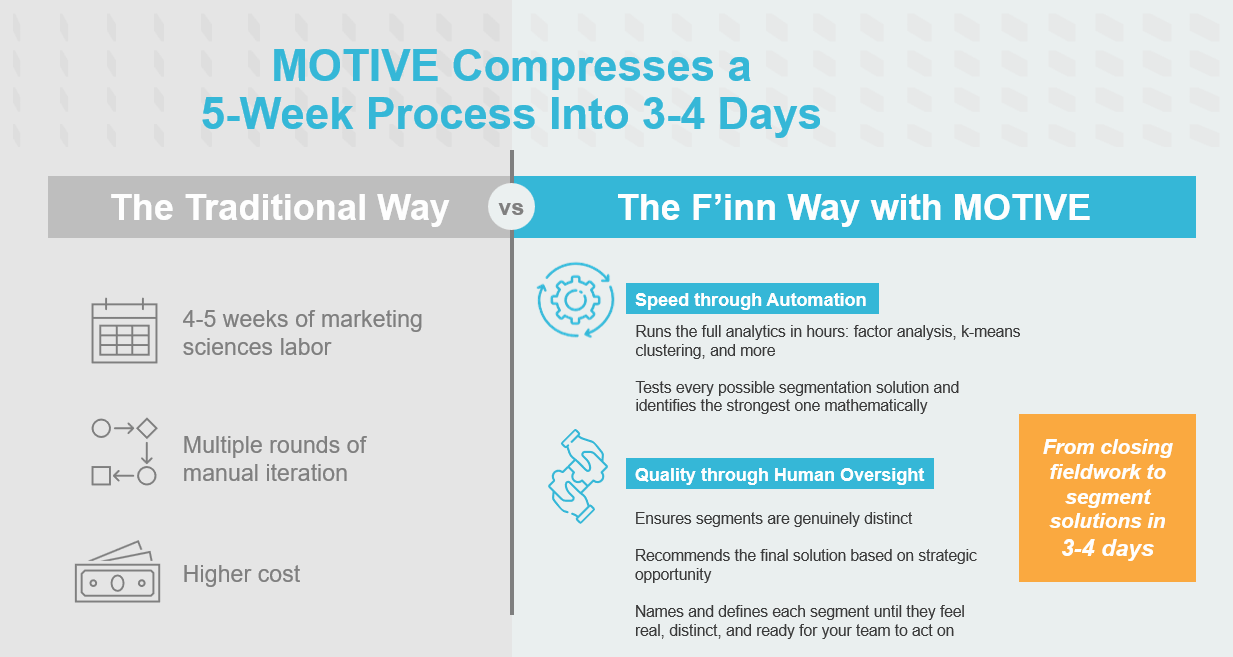
In our last F'inn AI Lab post, we promised to share what's working with AI as we find it. Here’s the first real breakthrough: MOTIVE, our motivation-based segmentation engine, compresses a month of marketing sciences labor into days. It runs factor analysis, k-means clustering, and predictive modeling with expert analysts in the loop where it matters most.
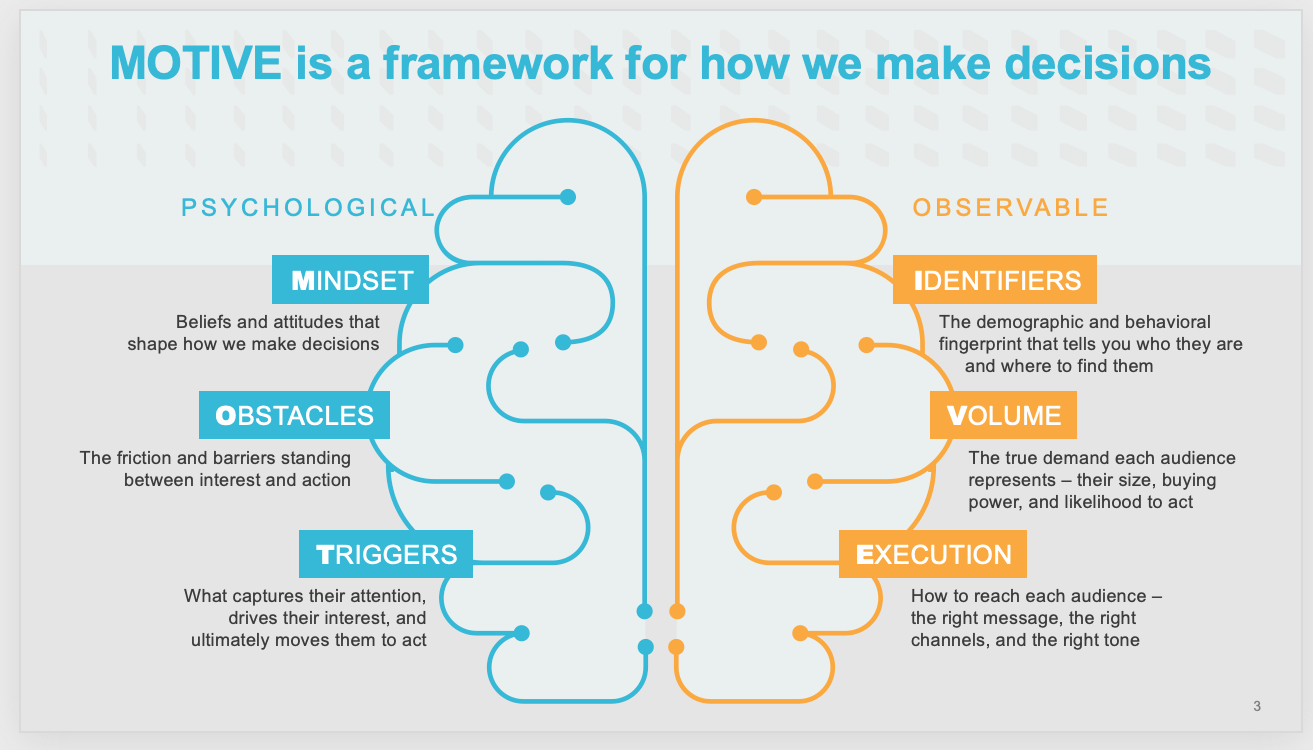
The output is a sized, prioritized set of audience segments, each one with the drivers pulling them toward “yes,” the barriers pushing them away, and clear guidance on how to reach them and what to say. MOTIVE is delivered in days due to speed through automation and quality through expert human oversight. That’s one of the best powers of AI right now, it can enhance us.
Running segmentation at this speed changes what’s possible. We're now applying motivational analysis across all types of research: enhancing likely buyer analyses, deepening our understanding of satisfied vs. dissatisfied customers, and uncovering what separates your brand buyers from the competition's. Every group you study has distinct audiences within it. MOTIVE makes it practical to find them.
If you have an upcoming (or even in progress) segmentation, a likely buyer study, or any audience / targeting questions where the usual outputs feel thin, reply here or email stephen@finn-group.com. Thirty minutes and we’ll show you what the deliverables look like.
More from the F’inn AI Lab coming soon.
Pulse Check
Every quarter, we run co-funded research with Harmon Research to get an early read on how people are thinking, behaving, and what technologies they’re adopting. We call it Pulse, as it’s how we catch shifts in sentiment and behavior in real time. For our upcoming wave, we’re focusing on Agentic AI and how ready consumers actually are to let AI act on their behalf. If you missed last month's piece on how this is already reshaping marketing and the rise of GEO, catch up here. Here is a quick question we’re investigating:
Imagine you order the same coffee every month from an online store. You have an AI assistant that tracks your orders and knows your preferences.
Tell us why!
What a UT McCombs Team Taught Us About Our Own Business
Every year, the University of Texas McCombs School of Business, one of the top MS programs in the country, runs a capstone program pairing student consulting teams with real companies facing real challenges. This past semester, we were one of those companies; and with two McCombs alums on our own team, Meira Rigley and Stacey Webb, we knew firsthand the quality of consultant and researcher this program produces. A five-person team of students, led by Elise Walsh, spent months conducting internal interviews with our leadership, external interviews with clients, and secondary research on B2B buyer behavior before delivering their findings.
We brought them in because we had a specific challenge. We have a decade of strong client relationships and high repeat business, however, we have been less successful in gaining awareness among those who do not already know us.
Their central finding was that we don’t have a conversion problem; we have an early-stage clarity and trust problem. Every communication we put into the world, from a capabilities deck to an email signature to a LinkedIn post, should point back to our core message of Strategic Insights. We felt that most clearly when they turned the lens on how we’d been sharing our research.
For years, we’ve gone deep on issues we believe our clients need to understand: six years of sustainability research, extensive work on mental health, ongoing Pulse findings, and more than 50 original articles documenting our experiments with AI. What the team helped us see is that we were too focused on educating clients on issues that would impact their businesses, and not focused enough on showing how we think. To a prospect who didn’t already know us, a deep dive on sustainability or mental health might only land if that topic was already on their radar. The team’s consistent message was that every piece of research we put into the world needs to do two things at once: help the reader and show them how we think.
Elise noted that delivering hard findings to a C-suite as graduate students is not a comfortable position. What she found was a team willing to listen and act rather than defend. From where we sat, we saw students who understood the problem, put themselves in our shoes, and genuinely cared about making a difference for our business. Their discipline and thoroughness demonstrated exactly why McCombs is so highly regarded. We're looking forward to continuing this relationship as part of their advisory committee.
Shout out to the whole team: Elise Walsh, Anya Gowda, Macey Marketos, Namah Kohli, and Yi-Sin (Chloe) Chin.

Happy (early) Mothers Day!
We know we’re early, but our moms deserve it (plus a good reminder to send your card now so it arrives in time). A special shout to the F’inn moms who are not only managing, organizing and leading F’inn, but managing, organizing and leading their families. We appreciate all that you do!
Lisa P, Lisa M, Marisa, Stacey, Megan, & Amber <3
Looking forward to seeing how F'inn continues to grow. I absolutely loved working with you all this semester!