


In part one, we showed that 43% of Americans now use AI to shop, that an AI model sits between brands and buyers reading everything and reporting a consensus, and that shoppers punish confident-but-wrong answers by leaving. This next part covers where we’re heading with agents that buy on their own, the next wave of shoppers who haven’t converted yet, and how to research a journey that happens inside a model.
From Decision to Default
The endpoint of this journey is delegation and it’s for boring stuff so far. Forty-two percent of shoppers would let an AI agent automatically reorder routine products but only 26% would let one select and buy a $150 pair of running shoes. Parents lead both figures at 56% and 40%, which makes intuitive sense, since time-starved, high-frequency households have the most to gain from handing it off. Comfort falls off sharply after age 50 and nearly disappears for discretionary purchases after 65. Among regular AI shoppers, comfort reaches 84% for reordering and 58% for the $150 discretionary purchase. The first delegation is the hard one. After that, the habit forms quickly.
Agentic reordering changes the journey. When the agent buys, there is no shelf, no ad, no comparison page, and no moment of reconsideration. The agent remembers a default and executes it. That memory is a new distribution source, and consumers are split on it: 38% are comfortable with AI remembering their preferences and purchase history while 35% are not. The default slot will exist either way but the open question in each category is which brand occupies it when the habit forms. Being the recommendation before habits stabilize is worth more than any single purchase, because what’s being won is every subsequent purchase the shopper never thinks about again.
The Next 37% Converts Differently
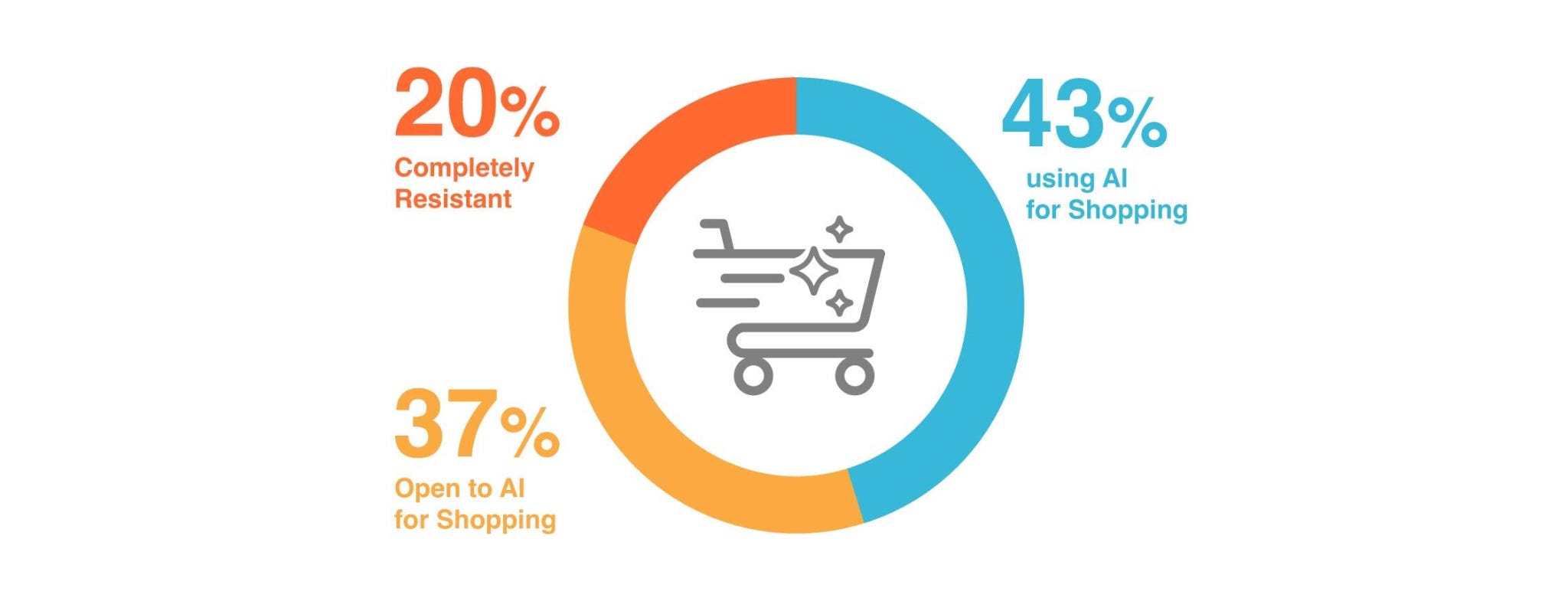
We’ve talked about the 43% who are already using it. The more useful question for planning is who’s next, so we looked at the 57% who aren’t shopping with AI by their attitudes and their existing AI behavior. Another 37% of all adults qualify as open to shopping with AI because they’re comfortable with AI recommendations or review summaries or they already use general AI tools for other purposes. For example, 54% of these “open non-users” already use ChatGPT or Gemini for other tasks. They’re using the technology but haven’t yet transferred the habit to shopping. That gap may resolve on its own as shopping features are integrated inside the tools they already use.
The open non-user segment also explains the gender gap. Women trail men on usage (34% versus 54%), but their openness rate is higher than men’s. The 20-point gap is a lag in conversion, and the brands and platforms that close it first will grab high-value adopters.
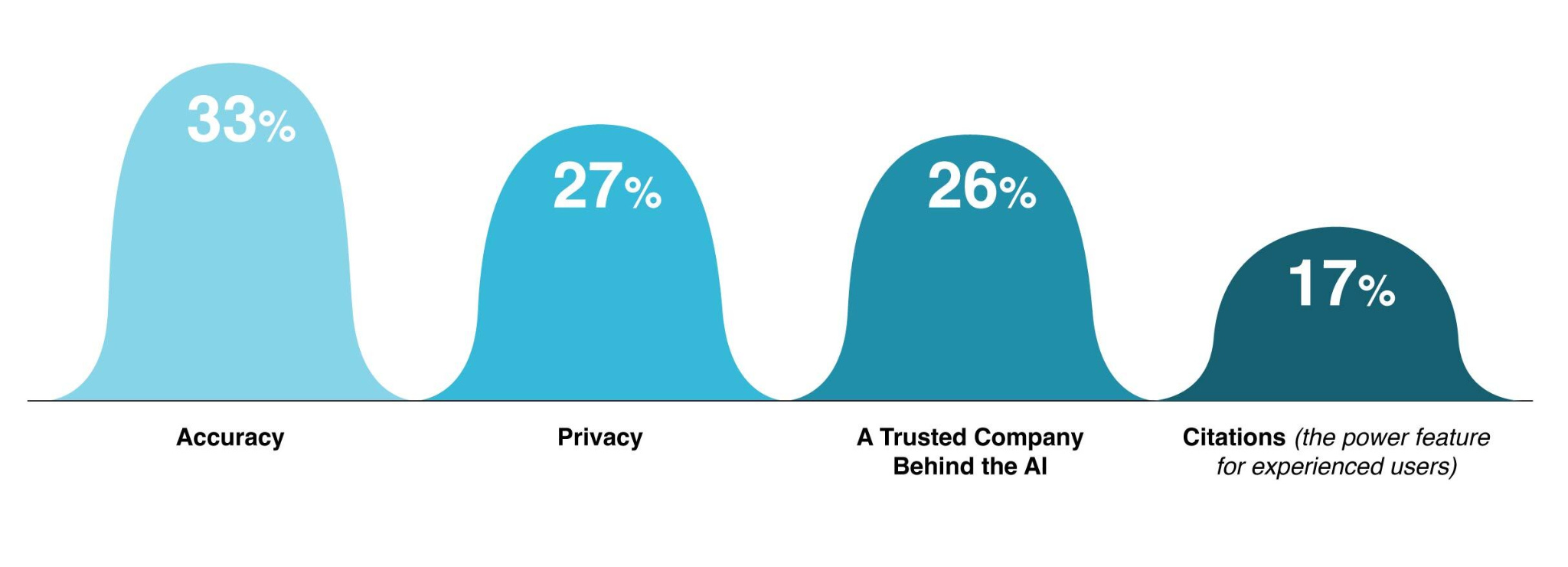
What converts this next wave is different from what won over the early adopters. Open non-users index high on accuracy (33%), privacy (27%), and a trusted company behind the AI (26%). However, citations, the power feature for experienced users, rank near the bottom for them (17%). These consumers will arrive through Amazon and Google who they already trust rather than through standalone chatbots, which means retail-platform representation is important for growth outside of chatbots.
Finally, about 20% of adults are fully resistant. They use no AI tools, 57% of them say nothing would build their trust, and they skew heavily toward tech late adopters. AI shopping will never reach 100% and spending against this segment is waste. But 43% current, 37% open, and a converting funnel in between means the market can roughly double.
Measuring a Journey You Can’t See
The most important part of the new journey happens inside a model, where no clickstream, no panel, and no survey question can directly observe it. That’s why we argue this moment demands three kinds of understanding at once.
Quantitative work sizes and tracks the shifts. Adoption, comfort by task, trust drivers, delegation thresholds, and subgroup movement are all funnel metrics, and they should be measured in waves like funnel metrics. These numbers will look different in six months. Qualitative work explains what delegation feels like, where the trust threshold sits in various categories, why the same shopper gives an agent the toothpaste and keeps the running shoes, what happens emotionally in the moment an AI gets their product wrong.
The third level is mechanical: know how retrieval and synthesis work, which domains get cited and why, how models resolve conflicting product claims, and how the web becomes a confident recommendation. Without understanding the mechanical layer, you can measure the symptoms and still misdiagnose the cause. You’ll see your brand losing AI recommendations and reach for more content, when the real failure is a spec-sheet contradiction between your site and your largest retailer. That’s unsuccessful GEO.
At F’inn, we examine what AI says about a brand and its products, verify those answers against facts, quantify the gaps and track them over time, and combine the measurement with qualitative work on how real buyers fold these tools into their lives. The customer journey moved somewhere harder to see, and the brands that treat their AI representation as a measurable, correctable research object will win. Start optimizing your GEO for a reader who is no longer the one reading.
Greg Robison, PhD
Founding Partner & CTO of F’inn
Methodology: F’inn general population survey, n=501 US adults, fielded June 2026. Subgroup bases: Millennials n=155, parents with children under 18 at home n=172, household income $100K+ n=139, men n=249, women n=246, regular AI shoppers n=97.