F'innews: Common Ground
July 31st: A Gen Z AI POV, Figma Config recap, and bipartisan agreement on cost-of-living (~5 minute read)

Why is the generation raised on tech rejecting AI?
In our self-funded quarterly pulse research (in collaboration with Harmon Research), we asked ~500 Americans across generations what would break their trust in an AI platform. As the resident Gen Z here at F’inn, I found it fitting to report on what we found in our research. Older generations pointed to data privacy. Gen Z pointed somewhere else entirely: confident misinformation and companies using their AI in unethical or harmful ways.

There’s a flip side to that first one. Accuracy barely registered as a trust builder for Gen Z, the lowest rate of any generation we surveyed. Accuracy isn’t something a platform earns credit for with us. It’s the floor. The trust question my generation is actually asking is an ethical one, and it’s aimed as much at the companies as the products. Gen Zs were nearly three times more likely than Gen Xers to say trust is built by an AI that declines harmful requests. We aren’t only evaluating whether these tools work. We’re watching whether these tools, and the people building them, will set boundaries to protect us.
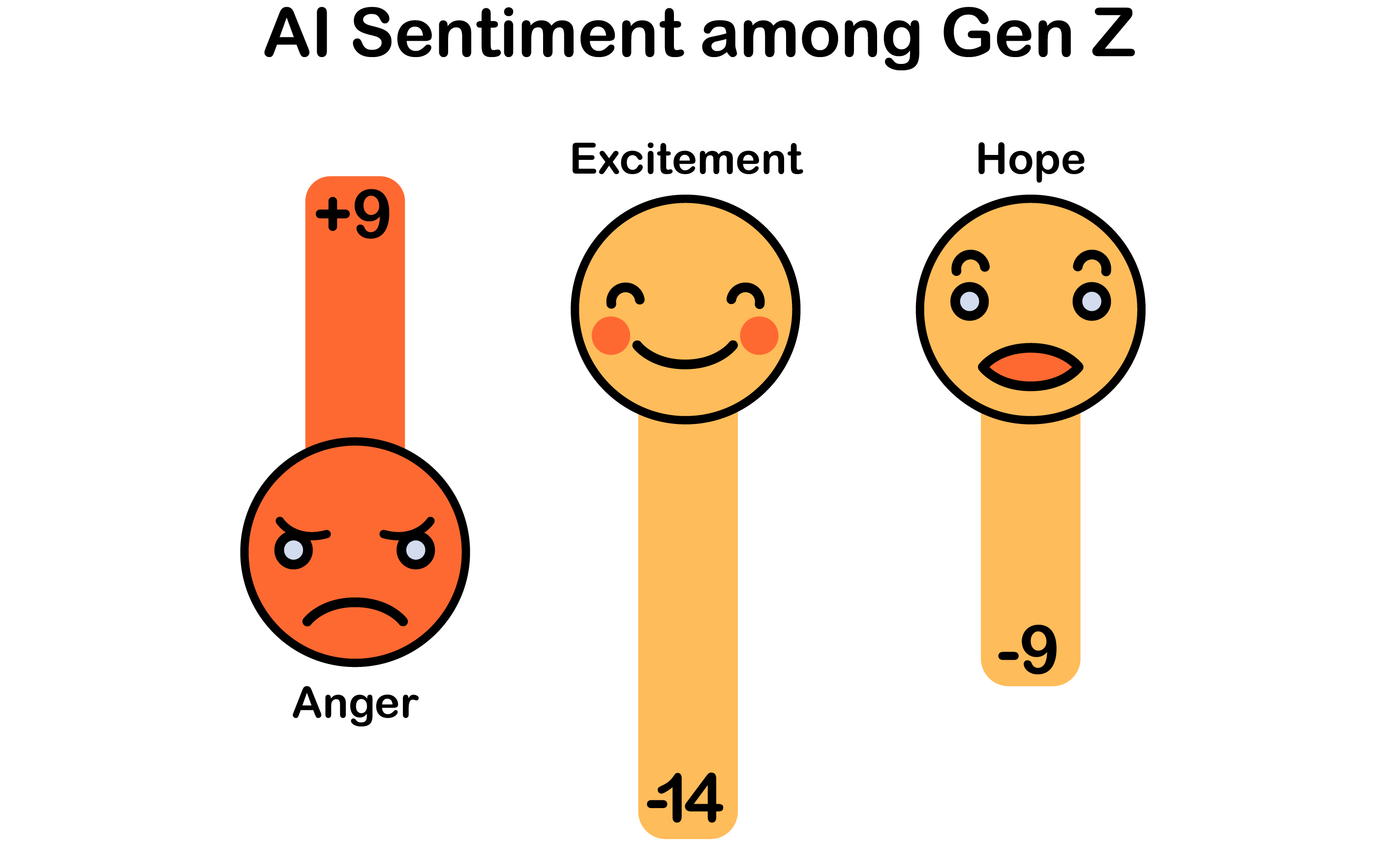
This tracked with what I’m hearing from my peers, and with what other research is finding. In a recent study from the Walton Family Foundation, GSC Ventures, and Gallup, hope and excitement about AI have fallen over the past year while anger and anxiety have climbed. The biggest shifts showed up among Gen Zs who use AI at least once a week. Fear or unfamiliarity aren’t what’s behind this. It’s the people with the most experience using these tools who are experiencing the greatest changes in perspective.
In the full article, I get into what that experience actually looks like. A job market where entry-level roles are the first thing companies hand to AI. A workplace where the Gen Zs who see AI in action every day are the most convinced its risks outweigh its benefits. And the concern I find most striking in the data: 80% of my generation think it’s likely that using AI will make it harder for them to learn in the future.
None of this makes my generation anti-AI. Curiosity is still the emotion Gen Z reports feeling most about these tools, and plenty of us are using them every day. AI comes with benefits, but Gen Zs like me are still figuring out whether it will do everything it promises and at what cost.
Read the full piece here.

Figma Conference ‘26
Last month, Jamie Woolfe and I attended Config in San Francisco.
I was a first timer and honestly had no idea what to expect; and in the end, was super impressed and energized after the two (2) days.

Felt a bit like an odd person out in a sea of designers and developers, however I am also one who believes in the value of seeking out the unknowns. And honestly, was surprised by how few researchers / insights minded attendees were present.
A few of my top takeaways:
We’re all figuring it out as we go when it comes to the adoption of AI; and the ‘that didn’t work’ moments are equally as important as ‘it’s working!’.
There’s great risk in overtrusting AI outputs; nothing should be considered ready to use without human oversight.
As we sit in the heart of the tech world, there’s great overestimation of non-techie people’s understanding and trust of AI and a fair amount of underestimation of AI’s limitations.
Agentic AI is akin to having a team who is always on the ready, super eager to learn and do, yet awaiting your next steer and constant feedback. Hyper specialization seems to be the current way of working among Designers and Developers.
AI’s adoption will be a demarcation in our history books; the term ‘the before times’ is already making it into the vernacular.
The topics and speakers seemed to naturally divide into two (2) core themes.
Theme 1 was ‘look at this super cool thing I made’; you might be able to do it too.
Theme 2 was personally more inspiring, which centered around the need to be people first vs. AI first when building and creating for people. This also dovetailed with honoring the wisdom and intuition we have all developed, and not self-forgetting as AI becomes more a part of our worlds.
Wrapping with my favorite line of the event: UXR is our guardian angel in all of this. They will keep us honest.

The Cost-of-Living Consensus
In November 2025 we surveyed 411 Americans nationwide and asked them to rank 30 policies by importance. Nearly a year into the current administration, the top five priorities were entirely about the cost of living. Trump voters and Harris voters put the same five issues near the top of their lists.
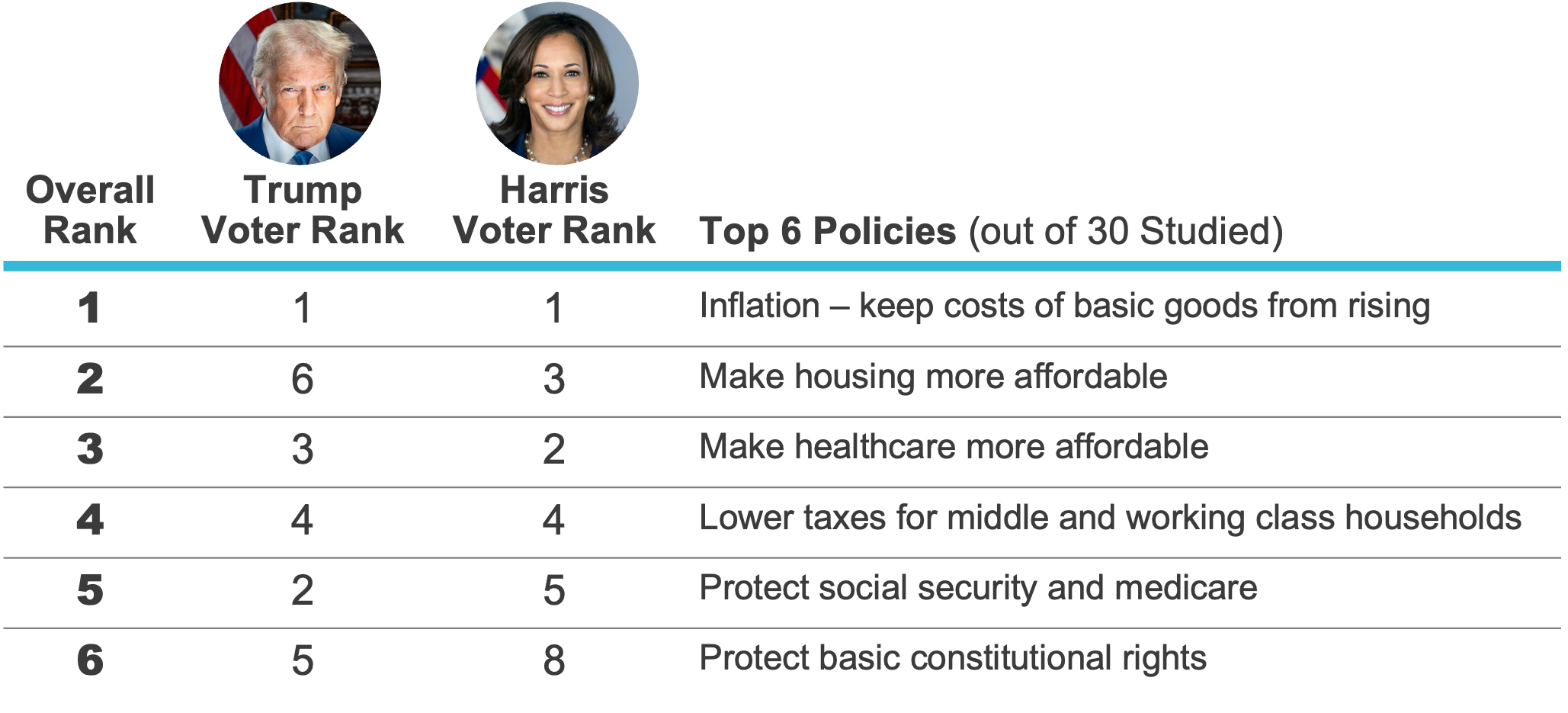
The sixth ranked item, protecting basic constitutional rights, was the only non-economic issue to crack the top tier, and both groups agreed it belongs there. Trump voters ranked it fifth. Harris voters ranked it eighth. While there are differences in the exact rank order, both voter groups agree that these five economic issues and protecting constitutional rights are among the nation’s top priorities.
The disagreements are real, and they’re roughly where you’d expect them to be. Trump voters place far more weight on border security, requiring able-bodied adults to work in order to receive government benefits, and protecting the rights of the unborn. Harris voters rank reproductive rights, renewable energy and climate investment, gun violence, and raising the minimum wage much higher. Border security is the starkest split of all: eighth among Trump voters, 27th among Harris voters. The full article has the complete rankings, including a few more issues outside the top five where the two groups end up agreeing.
What makes the consensus worth paying attention to is that it isn’t only showing up in survey data. Congress just passed the 21st Century ROAD to Housing Act with strong bipartisan support, which suggests the alignment we measured has some legislative pull behind it.
The open question is whether it holds. Will elected leaders continue efforts to tackle America’s cost of living challenges? Will voters hold them accountable to drive the economic changes that are needed? Whatever the answer, the data is clear that cost of living is where Americans agree, and it deserves to be the focal point of both policy and the political conversation.
If you want the full picture, including how all 30 policies ranked for each group, our complete write-up and the data behind it are linked here.